The world's firstbionicman Rex, created using nearly $1 million-worth of state-of-the-art limbs and organs - synthetic blood from SheffieldUniversity,prostheticlegs and ankle from MIT, retinas from OxfordUniversity, artificialkidneys, pancreas andspleensfromUniversityCollege London and artificial lungs from Swansea was unveiled at London's Science Museum on Thursday.
'Rex', a two metre tall artificial human, is displayed at the Science Museum in central London on February 5, 2013. The British robotics designers claim it is the world's first completebionic man, featuring artificial organs as well as fully functioning limbs. It will be on public display until March 11.
Rex is a mixture of Robocop and Frankenstein, Rex - who has the face of a man is 6.5-feet tall with striking brown eyes.
He was jointly built with the help of over 18 companies and universities and for the first time gives tangible hope that replacing body parts with man-made alternatives can finally be possible.
The 640,000 GBP (1 million US dollars) humanoid has a distinctly human shape and boasts prosthetic limbs, a functional artificial blood circulatory system complete with artificial blood, as well as an artificial pancreas, kidney, spleen and trachea. Rex has a distinctly human shape and boasts prosthetic limbs.
In the two centuries since Mary Shelley's Dr Frankenstein brought a 'monster' to life, the subject has fascinated science fiction in books, comics, film and TV. Now research on advanced prosthetic arms and legs, as well as artificial eyes, hearts, lungs - and even hybrids between computer chips and living brains - means that scientists are finally able to replace body parts and even improve on human abilities.
The project involves Bertolt Meyer, a social psychologist from Switzerland who has a bionic hand himself. He met scientists working at the cutting edge of research to find out just how far this new technology can go.
Bertolt has had prosthetic hands since he was a child. His new £30,000 bionic hand, which can grasp and twist, is the most advanced on the market. But technology is moving so fast that Bertolt's bionic hand could soon be obsolete.
A far more advanced arm is being developed, the product of more than $100 million-worth of research into bionic limbs, funded by the US military. Bertolt visited Michael McLoughlin at Johns Hopkins University's Applied Physics Laboratory to try out the latest prototype - the Modular Prosthetic Limb (MPL).
Draganflyer X8 8-Rotor UAV Helicopter Provides High Definition Wireless Video and High Resolution Photographs
The latest in aerial photography and videography is this Draganfly X8, a unique machine powered by eight motors, each with its own rotor blade! This stable flyer can carry 1.7 pounds of equipment and features 11 onboard sensors and a sophisticated autopilot to self-stabilize during flight. Its foldable carbon-fiber frame makes transport easy. Police departments across the U.S. and Canada are already using the Draganflyer X6, a smaller UAV, in search and rescue operations, training, surveillance and even homicide investigation.
Draganfly Innovations Inc. is announcing the release of the newDraganflyer X8helicopter, a miniature UAV for commercial/industrial aerial video and photography. The unique design utilizes eight main horizontal rotor blades and allows the Draganflyer X8 helicopter to hover efficiently and maneuver rapidly using differential thrust. Eight industrial electric motors allow the Draganflyer X8 to carry heavier and more advanced payloads while providing more safety features than ever before. The Draganflyer X8 will also be compatible with our latest technologies, including the handheld Ground Control Station (GCS) and IP video camera systems.
The increased payload capability of the Draganflyer X8 has allowed it to carry a select variety of digital SLR cameras and various 1080p video cameras. The Draganflyer X8’s industrial-strength electric motors provide increased thrust over the Draganflyer X6, which allows the Draganflyer X8 to carry an increased payload.
Innovative new camera systems will be offered as options for the Draganflyer X8 UAV, including the new IP video cameras. IP video cameras work by transmitting digital video over an 802.11n wifi connection. Digital video is less susceptible to random noise than analog video. Digital video is also more secure because IP cameras work over their own wireless network, which can be encrypted to protect the video stream from unauthorized viewing. Because the IP cameras are digital, they can record video to a buffer in internal memory before streaming it to the receiving station. This means that the cameras can be used to capture high resolution still pictures while video is being recorded. Video from the IP cameras can be streamed over the internet easily, allowing you to transmit your video live to almost anywhere in the world.
The Draganflyer X8 UAV will be our first UAV helicopter to offer the new handheld Ground Control Station (GCS) as an option. The GCS is currently in development; when complete, it will effectively contain all the features of both the handheld controller and the video base station in one handheld package. Running a Linux operating system on an Intel Atom™ processor allows the GCS to run our existing DraganView software and provide helicopter control at the same time.
Safety and durability have been incorporated into the design of each Draganflyer helicopter and the Draganflyer X8 is no exception. It offers more safety features than ever before. Even if an in-flight collision causes one of the motors to stop working, the Draganflyer X8 helicopter, with dual motors on each of the four arms, will still be able to fly using the remaining seven motors. Other safety features include high intensity LED navigation lights for distance or low-light flying and auto-landing if the radio link between the helicopter and its controller is lost. An onboard flight recorder stores telemetry and flight data in a removable memory card. This information can be used for post-flight analysis with our DraganView software.
The Draganflyer X8 UAV helicopter has been designed with a unique folding carbon fiber frame. This allows the Draganflyer X8 to become conveniently compact for storage and transportation. Once the Draganflyer X8 carbon fiber frame is folded, it fits securely in its back-packable case.
The Draganflyer X8 is a fully functional, miniature, unmanned, electric powered helicopter. Aimed at industrial and commercial use, it provides reconnaissance and inspection information using onboard wireless video (equipped with digital video recorders) and still images. The Draganflyer X8 helicopter achieves its stability by using an onboard processor running custom-designed Draganfly software and receiving data from eleven onboard sensors (three gyros, three accelerometers, three magnetometers, one barometric pressure sensor, and one GPS receiver). It is easily piloted by users with minimal training. The Draganflyer X8 helicopter determines its own orientation and motion, moving where the operator instructs it, automatically handling the complex attitude and altitude adjustments that would normally require an experienced pilot.
The Draganflyer X8 helicopter can be put into GPS hold mode where it will maintain its position without any user input. This means that once the GPS hold is activated, the pilot can concentrate on framing the shot using one of the various cameras that the Draganflyer X8 can carry.
The Draganflyer X8 helicopter is flown using a custom-designed handheld controller with a 2.8” color OLED touchscreen that displays telemetry and flight data. The Draganflyer X8 handheld controller receives streaming video sent by the helicopter and in turn, sends this video to a pair of video goggles. The video goggles enable the operator to view what the helicopter is seeing in real-time while also keeping an eye on the helicopter itself.
The increased payload capability of the Draganflyer X8 has allowed it to carry a select variety of digital SLR cameras and various 1080p video cameras.
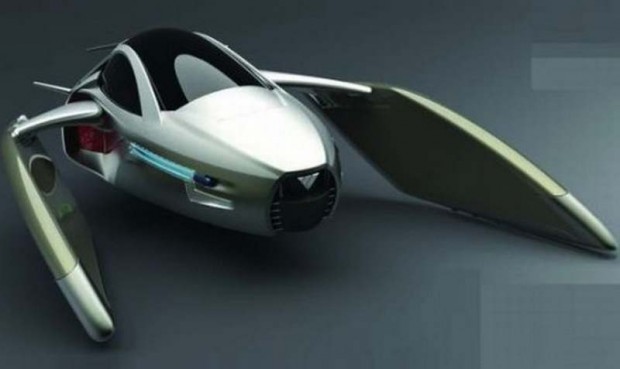
YEE is an ingenious vehicle that is capable of transforming into a flying machine instantly. Simply by upturning the front wheels sideways and rear wheels to the outside back, this interesting concept vehicle would take you away from a hectic traffic jam. The concept car has been envisioned to be powered by solar panels spread over its roof.
Three Chinese students from South China University of Technology(SCUT), Jiazhe Pan, Lai and Zhu Wenxi Zexin devised the concept YEE, a flying car, simply. They have created a concept car that can evolve on land and in the air.
For land mode, the wings are folded down and through the small wheels at their ends. Note the flying car has only two “real “ rear wheels.
Although the concept YEE has won the “Gold Award for Best Creative Future ” in Beijing, it is obviously impossible to achieve as presented in the current state of our technologies.
This DIY kit Robot has caterpillar type tracks and has a camera, Wi-Fi and an in-built microphone. Spykey even comes with its own software to enable it to be controlled from anywhere on the net. It has a functional webcam and a VOIP (Skype compatible) speaker phone. We only wish it would come in black or a Darth Vader model.
While the Spykee set can be built into three different robot models and is compatible with other Erector sets, the most intriguing aspect of the $280 kit for me is the telepresence capability: Spykee serves as a fully functional webcam and VOIP speakerphone; it’s even Skype compatible.